The short version
- ENERGY STAR says an efficient dishwasher uses about 3.5 gallons per cycle; hand washing a full load can take up to 27 gallons.
- Most of the energy in hand washing goes into heating that water.
- Scrape, don't rinse. Pre-rinsing under the tap throws away most of the dishwasher's advantage.
- Run full loads and use the eco cycle and air dry.
Plenty of people still believe that washing dishes by hand is the frugal, greener choice, and that the dishwasher is a luxury that wastes water. For a modern machine used sensibly, the opposite is usually true. The reason is hot water.
Water: the gap is bigger than you think
ENERGY STAR says a certified standard-size dishwasher uses about 3.5 gallons of water per cycle. Washing the same load by hand, with the tap running, can use up to 27 gallons. Even a careful hand washer with a filled basin and a rinse basin typically uses several times what the machine does.
Energy: where the cost really is
Most of the energy in dishwashing is the energy that heats the water. A dishwasher heats a small amount of water to a high temperature inside the machine. Hand washing pulls hot water from your water heater, and lots of it.
Here is a rough comparison, computed on stated assumptions. Say a hand-washed load uses 27 gallons, half of it hot, heated 70°F from cold. That is about 7,900 BTU, or roughly 2.3 kWh with an electric water heater: about 40 cents at 17 cents per kWh. A dishwasher cycle at about 1.3 kWh costs about 22 cents and uses a fraction of the water. With a gas water heater the hand-washing energy cost is lower, about 20 cents, but you still pay for the extra water and sewer.
A very frugal hand washer can beat the machine. Most people, rinsing under a running tap, do not.
Run the dishwasher the efficient way
- Scrape, don't rinse. Pre-rinsing under hot water can use more water than the whole dishwasher cycle. Scrape food off and load the plates as they are.
- Wait for a full load. A half load uses nearly the same water and energy as a full one.
- Use the eco or normal cycle. Heavy and sanitize cycles use hotter water and more of it. Keep them for really dirty loads.
- Air dry. Turn off heated dry, or open the door a crack at the end of the cycle.
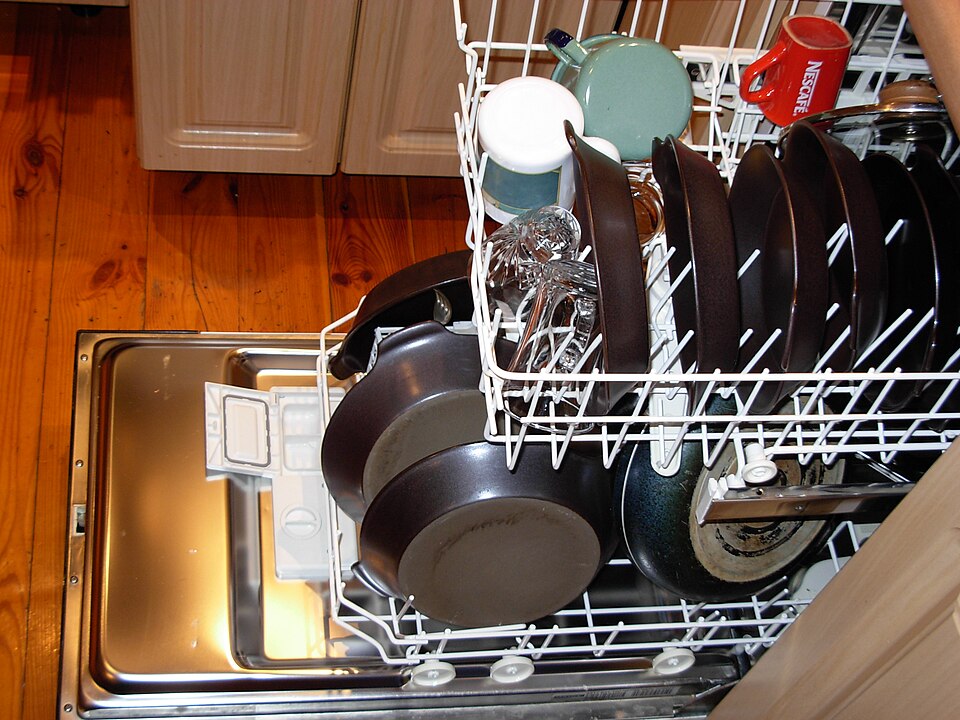
- Load it properly. Plates facing the center, cups and bowls angled down on the top rack, nothing blocking the spray arms. A badly loaded machine leads to rewashing by hand, which cancels the savings.
- Clean the filter. Many modern dishwashers have a removable filter at the bottom that needs rinsing every few weeks.
Off-peak timing
If your utility charges time-of-use rates, the delay-start button is worth using. Starting the cycle after the evening peak ends costs less for exactly the same wash. Our guide to time-of-use rates explains how those plans work.
Is it worth replacing an old dishwasher?
Dishwashers made before the mid-2000s often used much more water per cycle than today's models. If yours is old and needs a repair, the efficiency gain is a reasonable tiebreaker in favor of replacing it. If it works well, run it full and on eco, and keep it. Hot water is the larger lever in most homes: see our guide to setting your water heater temperature.
Questions people ask
Does a dishwasher use a lot of electricity?
Not much. A modern dishwasher uses roughly 1 to 1.5 kWh per cycle including heating its own water, so about 17 to 26 cents at 17 cents per kWh. The heated dry option adds a little; air drying avoids it.
Should I rinse dishes before putting them in the dishwasher?
Scrape food into the trash or compost, but skip rinsing. Modern detergents work best with some soil to act on, and many machines have sensors that adjust the cycle to how dirty the water is.
Is it bad to run a half-empty dishwasher?
It is not harmful, but it uses nearly the same water and energy as a full load. Waiting until it is full is one of the easiest savings.
Sources
Numbers on this page are estimates built on the stated assumptions. Your rates, climate and home will change them, so plug in your own figures. Nothing here is financial or professional advice.