The short version
- The US Department of Energy recommends 120°F for most households.
- DOE: each 10°F reduction saves about 3–5% of water heating costs.
- Water heating is around 18% of a typical home's energy use, the second-largest share after space heating and cooling.
- If anyone in the home has a weakened immune system, ask a doctor before lowering the setting.
Your water heater is probably the second-largest energy user in your home, and it is the one appliance nobody looks at. It sits in a closet or the garage, holding 40 or 50 gallons of water at a steady temperature around the clock. That temperature is a single dial, and many are set higher than they need to be.
The recommended setting
The US Department of Energy recommends setting your water heater to 120°F. Many manufacturers ship tanks at 140°F, and many installers leave them there. The difference matters for two reasons.
The first is energy. A hotter tank loses more heat through its walls and through the pipes, all day and all night. The DOE says that for each 10°F you lower the temperature, you can save about 3–5% on water heating costs.
The second is safety. Water at 140°F can cause serious burns in seconds, which is a particular risk for young children and older adults. At 120°F it takes much longer.
What turning it down saves
The DOE estimates water heating accounts for around 18% of a typical home's energy use. Suppose your household spends $500 a year to heat water. Dropping from 140°F to 120°F is a 20-degree reduction, so 6–10% by the DOE rule, or roughly $30 to $50 a year. It costs nothing and takes five minutes.
How to check and change the temperature
- Measure first. Run hot water at the tap nearest the water heater for a minute or two, then hold a cooking thermometer in a glass of it. That reading is what you actually get.
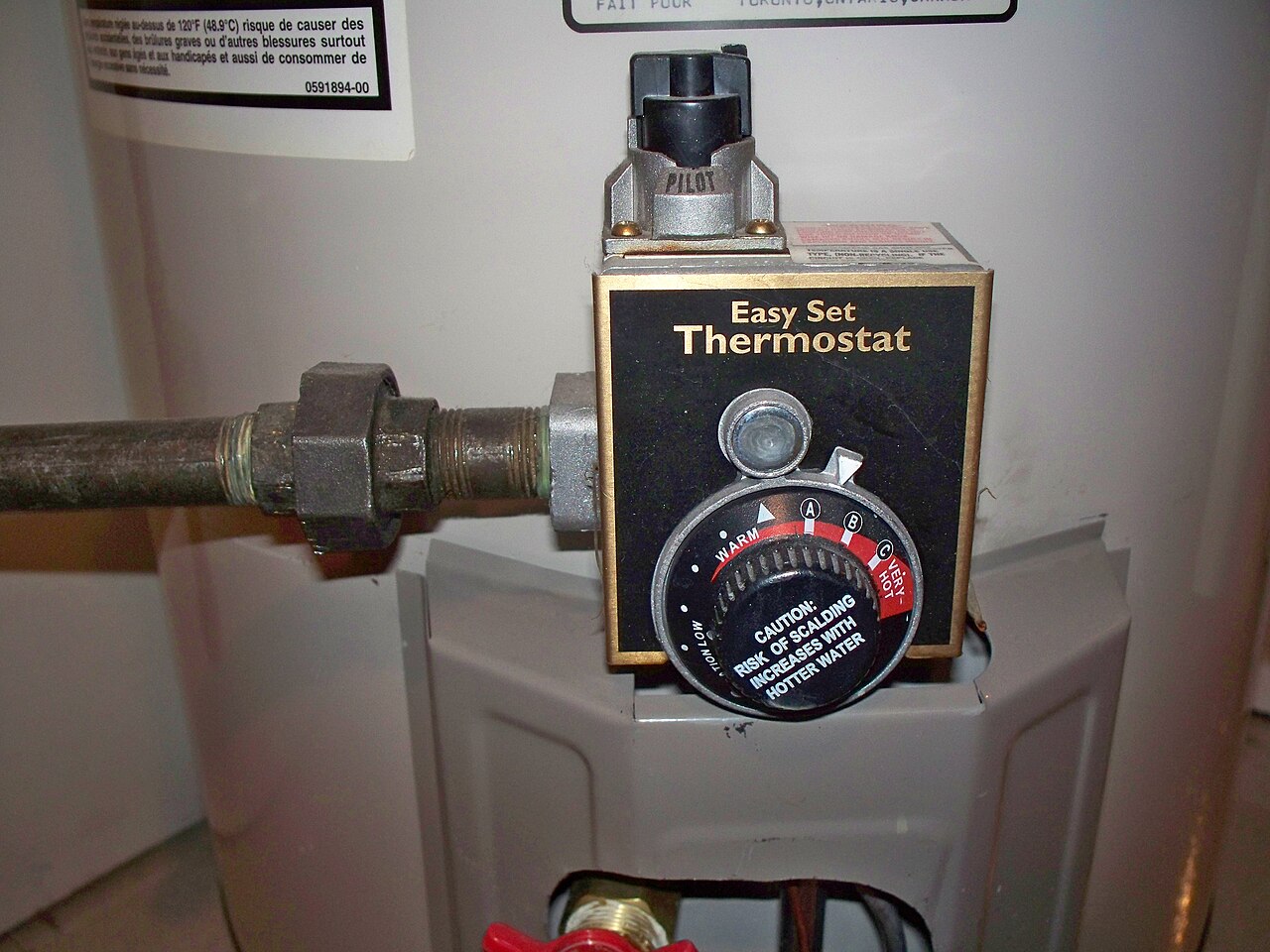
- Find the control. Gas tanks have a dial on the gas valve at the bottom, often marked "warm", "hot" and "very hot". Electric tanks usually have one or two thermostats behind metal access panels.
- For electric tanks, turn off the power at the breaker first. The thermostats sit next to live wiring. Remove the panel, fold back the insulation, and adjust with a flat screwdriver. Set both thermostats to the same temperature, then replace the insulation and panel before turning the power back on.
- Wait and measure again. Give it a few hours, or until the next morning, and test at the same tap. Adjust in small steps.
If you are not comfortable working near the electrical parts, a plumber or electrician can do it during any routine visit.
The health trade-off, plainly
There is a genuine debate here. Legionella, the bacteria behind Legionnaires' disease, grows in warm water, and some public health guidance favors storing hot water at 140°F, with thermostatic mixing valves to bring the temperature at the tap down to a safe level. For most healthy households, the DOE's 120°F is the standard advice. If anyone in your home is elderly, a smoker, has chronic lung disease or a weakened immune system, ask a doctor which setting suits you.
Other ways to cut water heating cost
- Wash clothes in cold water. ENERGY STAR says about 90% of a washer's energy goes to heating water.
- Fit low-flow showerheads and fix dripping hot taps.
- Insulate the first few feet of hot water pipe from the tank, and the tank itself if it is an older model that feels warm to the touch.
- Use vacation mode when you are away for more than a couple of days.
- Flush sediment from the tank as the manual recommends. Sediment insulates the water from the burner or element.
When the tank eventually needs replacing, it is worth comparing a standard tank, a tankless unit and a heat pump water heater. Our guide to tankless versus tank water heaters lays out the running costs.
Questions people ask
Is 120 degrees hot enough for a dishwasher?
Most modern dishwashers have their own heater and raise the water temperature as needed, so 120°F from the tank is fine. Check your dishwasher's manual if you have an older model without a booster heater.
Does lowering the water heater temperature risk Legionella?
Legionella bacteria grow best in warm water, and some health guidance favors storing water at 140°F with mixing valves to prevent scalding at the taps. For most healthy households the DOE's 120°F recommendation is standard. If someone in your home is elderly, a smoker or has a weakened immune system, ask a medical professional.
Why is the dial marked 'hot' and 'warm' instead of degrees?
Many gas water heaters use vague markings. Measure the temperature at a tap with a kitchen thermometer, adjust the dial, wait a few hours and measure again.
Sources
Numbers on this page are estimates built on the stated assumptions. Your rates, climate and home will change them, so plug in your own figures. Nothing here is financial or professional advice.